Business
& Management Residential Faculty
Estrella
Mountain Community College
I''m completing
my academic Career at Estrella Mountain Community
College. Being the first person to move onto this
Estrella Mountain Community College campus means
I've practiced my profession here more than 15
years.
May
practice make perfect.
I must have
taught more than 3000 students since I average
about 180 students per semester and have graduated
at least 750. Anywhere I go I run into people who
say
"Hello
Dr.
Bradley"
to
which I reply
"Hi,
how are you doing"
since
I usually haven't a clue as to his or her name.
So far no one has threatened my
life.
I am more
a trainer than an academic.
My
introduction to this craft was training mechanics
to fix International Harvester Combines. That
foundation lingers. To me the teaching and learning
process is about people quickly and easily becoming
able to perform practical and complicated tasks. I
know I am doing the right thing when students have
fun in class then leave able to make their dreams
come true.
I have had a lot
of teachers.
"You
open more than books, you open minds."
Danessa
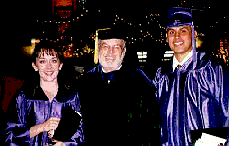
Garcia gave me a plaque thus inscribed as she
introduced me to her son and parents after
graduation. Danessa was one of the first persons to
earn an Associate of Applied Science Degree in
Organizational Management. Danessa was a powerful
teacher.
Danessa
opened my mind.
A little
background. Being in the right place at the right
time in 1988 resulted in me becoming The Maricopa
Community Colleges Occupational Program Specialist.
Faculty were being "laid-off" because only half as
many students were enrolling in business, computer
and management courses in 1988 as had enrolled in
1978. Almost no one was graduating with a
career-field degree. Crisis made it possible to
create meaningful change.
The flexible
Organizational Management at Estrella Mountain
Community College was the dream of a big-picture
woman named Bertha Landrum. Bertha believed making
courses relevant to current employment requirments,
making it necessary for faculty to compete for
students and making it possible for each student to
attain his or her personal career goal would be
good for students, their families, their community
and their college. Moving from the Maricopa
District Office to Estrella Mountain Community
College in 1992 made it possible for me to
actualize Bertha's dream. Recently I learned the
flexible Organizational Management program has had
the fourth highest number of graduates in the
entire Maricopa Community College district each
year for the past four years.
The
Organizational Management program consists of
Academic, Job Training and Management courses:
Complete all three to earn a degree. Prior to
Danessa's graduation I concentrated on guiding
students towards completion of the six Management
courses it takes to receive a Certificate in
Organizational Leadership. Danessa was Assistant
Manager for a large corporation where a
baccalaureate degree was the ticket to the
executive suite.
Danessa
needed more.
Teaching
is my life but I live for the interruptions, people
dropping by looking for an answer to the
"What am I going to be when I grow up"
question.
Knowing
Danessa's dream made it clear I needed to help
people do more than earn a six-course certificate.
Dale Parnell, former President of the American
Community College Association, forcefully explained
why quality career advisement is important.
According to Dr. Parnell, students who have a
serious career goal do better in college than
students who lack such a goal -- even if they keep
changing their minds.
Danessa wakened
in me the need to help each student identify his or
her personal
"Career
Potential Position -- the one job he or she must
have before death if they hope to get into
heaven."
I now do my
best to help every Organizational Management
program major create a vision of themselves in a
career that makes it possible fto express their
personality by doing what they enjoy most and do
best.
_________________________________________________
|
Knowing
who one is, is important because each career has a
personality just like each person has a
personality.
As
anyone who has ever had me as a professor knows,
the reason jokes about absent-minded professors are
funny is that, that characterization describes me.
But this personality works for me because of the
career field in which I live. Majors now use my
interactive on-line Career
Development
Program
to learn who
they are, what they like doing most and what they
are best at doing.
Doing is
as important as knowing.
Many
people envy the sense of self that comes from being
a medical doctor. However, this prestigious
profession loses some of its glamour when one
realizes many medical doctors are "on-call" 24-7
most of their life making it very difficult to have
a normal family life and that working intimately
with sick people makes one often ill as well. There
is no substitute for real life experience. In other
words I teach students to dream of themselves in
their Career Potential Position, to draft a Career
Development Plan that will make their dreams come
true and to then try it
out.
So
yes, I like teaching but what I love is helping
people win at the game of life.
Most of us
remember a teacher who taught us something that
changed our lives. What most students do not
realize is that learning goes both ways. Danessa
Garcia was the motivating force behind much of what
I now do for my majors and myself.
College
is really about "making dreams come
true."
I was open to
Danessa's lesson because an Industrial Psychologist
named Dr. Rupert Evans was my mentor. He taught
performance was a function of both attitude and
ability. As a University of Illinois professor, and
consultant to both President Kennedy and President
Johnson, it was he who insisted on inclusion of a
career development component into vocational
education programs. He did this because training
people for soon to be obsolete jobs inhibits
development of human potential and is therefore bad
national policy.
Career
advisement and informed self-determination are the
foundations of every course I teach.
In October 1995
Estrella Mountain Community College faculty
gathered in MON253, were shown an Internet Browser
named "Mosaic" and told,
"There's
a revolution going on all across America as we
speak."
By May 96 all my
lectures were converted to HTML and made accessible
on-line, in-class and to students outside of class.
Going on-line made it possible to bring real-time,
real-world information into the teaching and
learning process -- something none of us was
previously able to do.
Now
Estrella has Blackboard.
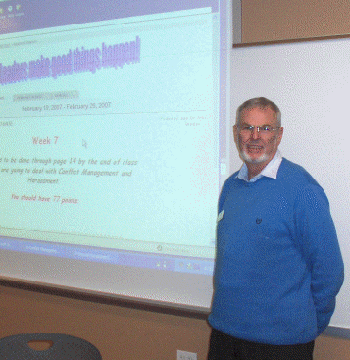
Blackboard makes
it possible for busy students with full-time jobs
to keep up with their classmates even if they must
miss class. Because all my content is now on-line
Blackboard also makes it unnecessary for my
students to purchase textbooks, which decreases
their degree-related debt. Placing formative
assessments on-line for students to complete on
their own makes it unnecessary for me to write,
reproduce, handout, collect, grade and return
quizzes which frees time for me to perfect my
courses, advise Organizational Management majors
and improve the quality of the Organizational
Management Program. I now have time to meet with
students face to face.
The
Internet and Blackboard have humanized the teaching
learning process.
There are too
many mentors to thank: Paul Elsner whose dreams I
have been trying to make come true. Dr. Wayne Ramp
who encouraged me to become more than an academic.
Stephen Shriver who taught me the top-level
management point of view and business ethics.
Bertha Landrum who taught me the value of asking
questions and listening for answers. Reverend
Eugene Lebever who taught me most of the theology I
absorbed. Dr. Roger Yohe whose enthusiastic embrace
of all things technological rescued me from
obsolescence.
Now all I
can do is pay all the gifts I have received from
the above and thousands of colleagues, family and
students forward by mentoring as many youth as I
can reach in my waning years.
|